

When You Can't Find Your Own Products (And What to Do About It)
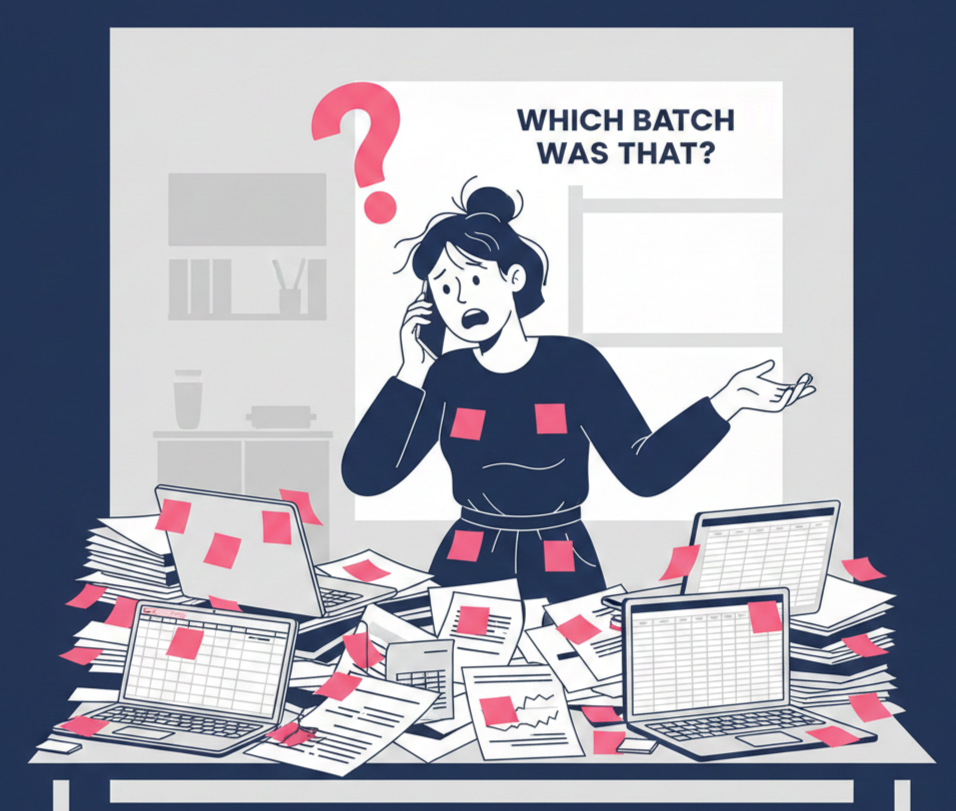
Here's a question: If someone asked you right now which batch of your product shipped to your biggest customer last month, could you answer them?
If you're sweating a little, you're not alone.
Most founders I talk to have their recipes perfected, their branding on point, and their sales growing. But ask them to trace a product batch or tell you how long their supplier takes to deliver packaging, and suddenly it gets quiet.
This isn't a "nice to have" thing. This is a "your business could implode without it" thing.
Let me show you what I mean.
The $30K Wake-Up Call
Working with a startup doing about $500K annually. They made amazing products - customers loved them. But they were tracking everything in their head.
Product names were different in Shopify, QuickBooks, and their supplier orders. They had no idea which supplier took 2 weeks versus 8 weeks to deliver. And when a customer reported a quality issue with one of their products, they had no way to know which production batch it came from.
Here's what that chaos actually cost them:
They found $30K worth of products just sitting there because they didn't realize they had overordered
They ran out of bestsellers twice because they didn't track how long packaging took to arrive
They spent hours every week just figuring out what to call their own products across different platforms
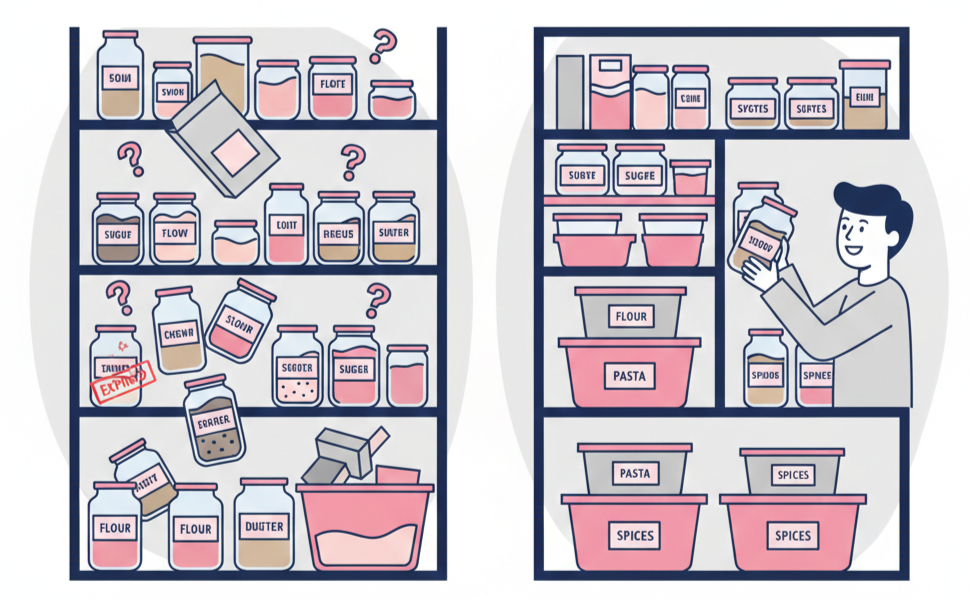
Think of it like running a kitchen where every recipe card calls the same ingredient something different. One says "sugar," another says "sweetener," and a third says "white granules." You'd waste so much time just trying to bake a cake.
The Three Systems Every Product Business Needs (Explained Simply)
Here's what was missing - and what every product-based business needs to have written down:
1. A Single Source of Truth for Product Names This is just a list that says "This product is called THIS everywhere." Your SKU system (SKU just means "stock keeping unit" - a fancy term for product code).
Think of it like your contacts list in your phone. You don't save your mom as "Mom" in one place, "Mother" in another, and "Sarah Johnson" somewhere else. You pick one name and stick with it.
2. Supplier Timing Records This tracks how long each supplier actually takes to get you stuff. Not what they promise - what actually happens.
It's like knowing your friend who says "I'll be there in 10 minutes" actually means 30 minutes. You plan accordingly.
3. Batch Tracking This is your "receipt" for every production run. When you made it, what went into it, where it went.
Imagine if you baked 100 cookies and one person got sick. Without batch tracking, you'd have to throw out ALL your cookies forever. With it, you know it was only cookies from Tuesday's batch using the vanilla from Supplier B.
The Fix (It's Simpler Than You Think)
Here's the framework that works:
STEP 1: WRITE IT DOWN Pick one name for each product. One code. One way to identify it. Write it in a simple spreadsheet. This becomes your "dictionary" that everyone uses.
STEP 2: TRACK THE TIMING
For each supplier, write down: What you order, when you ordered it, when it actually arrived. After 3-4 orders, you'll see the pattern. That's your real lead time (the time between ordering and receiving).
STEP 3: NUMBER YOUR BATCHES Every time you make products, give that batch a number. Write down the date and any important details (like which supplier the ingredients came from). That's it.
This isn't fancy. This is the business equivalent of writing "milk expires on Friday" on your calendar so you remember to use it.

What This Actually Gets You
When you have these three simple systems in place:
✔️ No more "What do we call this?" conversations wasting everyone's time
✔️ You order before you run out because you know exactly when to reorder
✔️ One quality issue doesn't tank your whole business - you know exactly which batch to recall
✔️ Your systems can actually talk to each other because everything uses the same names
💡 The Real Win: You stop operating on memory and gut feelings. You start operating on facts.
🏃 Do This Today: Write down your top 5 products and what you call them in every system you use. If the names don't match, you've just found your first problem to fix.
Your Starting Point
I built the three templates my clients wish they'd had from day one:
SKU & UPC Master List - One source of truth for all your product codes across every platform
Supplier Lead Time Tracker - Know exactly when to place orders so you never run out (or waste cash on storage)
Lot Code & Traceability Log - Track every production batch so you can handle quality issues without panic
Each template takes less than 20 minutes to set up. They're the same ones I use with clients who pay thousands for operations assessments.
These won't solve all your operational problems. But they'll prevent the most expensive, most common mistakes I see founders make.
Start here. Then if you need more help building the systems that let you scale, you know where to find me.
P.S. Downloaded the templates but stuck on how to actually implement them? Reply to this email. I read every response and I'm happy to point you in the right direction.
